



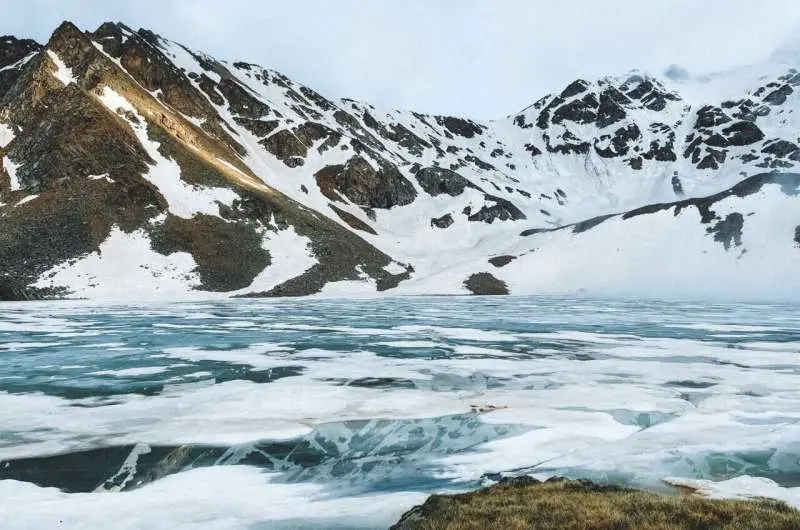
Lakes may cover only a small fraction of Earth's surface, but new research suggests they play a bigger role in regulating the planet's climate than previously recognized. By reflecting sunlight back into space when covered in snow and ice, lakes in the Northern Hemisphere have a stronger cooling effect than the surrounding land.
Dr. Sarah Cooley of Duke University and colleagues say their results highlight an overlooked part of Earth's climate system that could be better represented in climate models, which scientists use to understand how the planet responds to changing environmental conditions.
Why frozen surfaces matter
Snow and ice play an important role in regulating Earth's temperature because their ability to reflect sunlight helps limit the amount of solar energy absorbed by the planet, producing a cooling effect known as the cryosphere radiative effect.
However, snow and ice do not cover the landscape uniformly, and the way they behave can vary depending on the underlying surface. Lakes, for example, can retain snow and ice differently from the surrounding land, potentially influencing how much sunlight is reflected back into space over the course of a year.
To investigate this, the team analyzed 22 years of satellite observations, comparing seasonal snow cover and the amount of sunlight reflected by lakes and nearby land across the Northern Hemisphere.
Small footprint, big effect
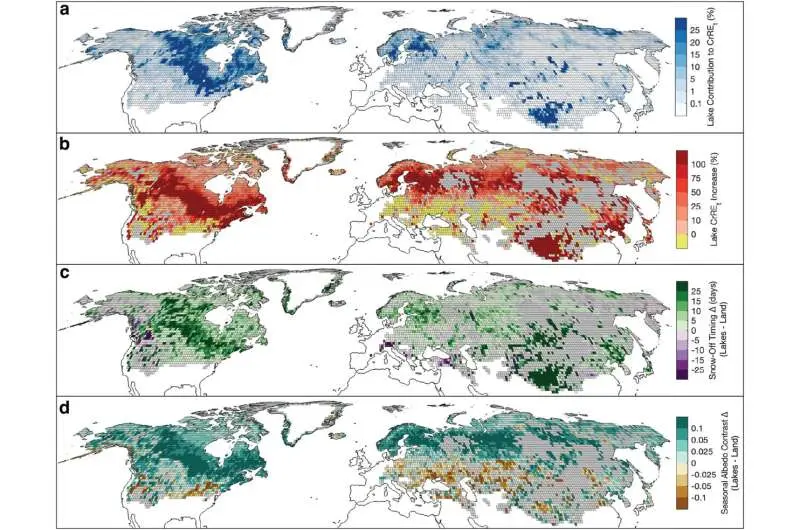
The analysis, published in Geophysical Research Letters, found that lakes have a substantially greater cooling effect per unit of area than the surrounding land: −14.4 watts per square meter over lakes, compared with −8.2 watts per square meter over land. This difference means lakes contribute more to the reflection of sunlight than their relatively small surface area might suggest.
The effect was particularly pronounced in boreal forests, which are dominated by coniferous trees and stretch across large parts of northern North America, Europe and Asia. In these regions, lakes can account for more than a quarter of the cooling effect from snow and ice.
The researchers also found that lakes' contribution becomes particularly important in late spring, when snow and ice are beginning to disappear from the landscape.
Keeping their cool
Two main factors help explain why lakes have a stronger cooling effect than nearby land. The first is that snow tends to melt earlier on land, meaning the ground begins absorbing more sunlight while nearby lakes remain covered in reflective snow and ice. The second is that snow-covered lakes reflect a greater proportion of incoming sunlight than snow-covered land, which scientists refer to as having a higher albedo.
Together, these differences mean lakes can continue reflecting sunlight at a time when the surrounding landscape has already begun to absorb more of the sun's energy. This is particularly significant during the transition from winter to spring, when the amount of snow and ice across the Northern Hemisphere changes rapidly.
A missing piece of climate models
The researchers argue that lakes' contribution to the cooling effect of snow and ice should be better accounted for in climate models, which help scientists understand how different parts of the Earth system interact and how changes in the environment could influence future temperatures.
Although models already account for the effects of snow and ice on the climate, the specific contribution of lakes is often not distinguished from that of the surrounding land. That could mean an important part of the seasonal energy balance is not fully represented.
However, the findings do not mean that lakes can offset the effects of global warming. Rather, they reveal another component of the climate system that needs to be considered alongside other processes affecting the planet's energy balance and what it means for Earth's future.
Written for you by our author Hannah Bird, edited by Gaby Clark, and fact-checked and reviewed by Robert Egan—this article is the result of careful human work. We rely on readers like you to keep independent science journalism alive. If this reporting matters to you, please consider a donation (especially monthly). You'll get an ad-free account as a thank-you.
Publication details
Sarah W. Cooley et al, Lakes Modify the Magnitude and Timing of the Northern Hemisphere Terrestrial Cryosphere Radiative Effect, Geophysical Research Letters (2026). DOI: 10.1029/2026gl124236
Who's behind this story?

Hannah Bird
PhD Earth Sciences in oceanography and paleontology. 10+ years translating complex science for mainstream media audiences. Full profile →

Gaby Clark
MA in English, copy editor since 2021 with experience in higher education and health content. Dedicated to trustworthy science news. Full profile →

Robert Egan
Bachelor's in mathematical biology, Master's in creative writing. Well-traveled with unique perspectives on science and language. Full profile →
© 2026 Science X Network
Citation: Overlooked lakes may be helping to keep the Northern Hemisphere cool (2026, September 29) retrieved 29 September 2026 from https://phys.org/news/2026-09-overlooked-lakes-northern-hemisphere-cool.html
This document is subject to copyright. Apart from any fair dealing for the purpose of private study or research, no part may be reproduced without the written permission. The content is provided for information purposes only.