



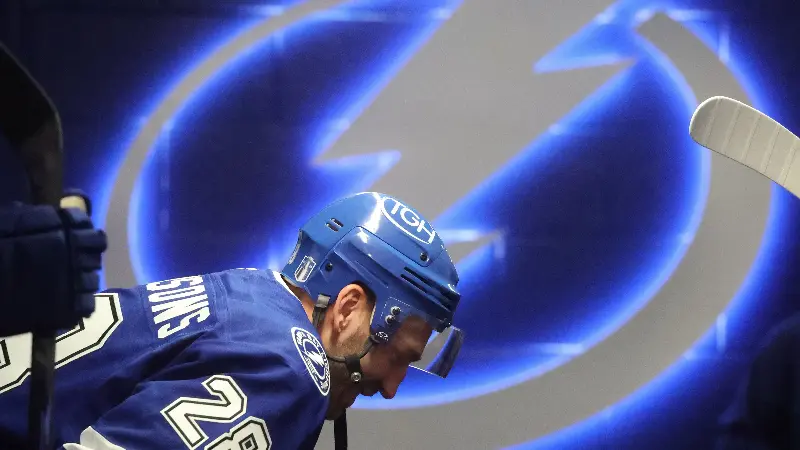
TAMPA, Fla. — Save the angst for later. All the second-guessing, too.
We’ve been in Stanley Cup-or-bust mode for so long around here that we’ve lost sight of what’s actually in front of us:
An unprecedented run of success by a team from Tampa Bay.
Did you know, since Jeff Vinik purchased the franchise in 2010, the Lightning have made as many postseason appearances and won more playoff games than any team in the NHL? That’s 16 years of sustained excellence, and the Lightning still have not fallen off a cliff.
If you don’t find that impressive, then you might not have lived through the Buccaneers creating high art out of screwing up in the 1980s. Or the first decade of Devil Rays baseball when they lost more frequently than any expansion team in history. Heck, even the Kokusai Green/Art Williams/Oren Koules eras of Lightning hockey.
And yet, we seem to go into each Lightning season — and I am as guilty of this as anyone — by nitpicking our way through the previous year’s shortcomings. And, yeah, if the Lightning begin this October by losing six of their first seven games like they did in 2025, I’ll be kvetching from the rafters like the rest of you.
But no matter how this season turns out — and the Lightning are among a half-dozen or more teams being mentioned as Stanley Cup contenders — the idea that a generation of fans in Tampa Bay have begun every fall with the look of unbridled optimism is something worth celebrating.
“The funny thing is, I heard all about it before I even got here,” said defenseman J.J. Moser, who was traded to the Lightning in the summer of 2024. “As soon as I got traded, everybody I talked to said, ‘Oh, you’re going to love it there. It’s such a top-class organization.’ Before I ever talked to anyone in Tampa, I already had an idea of what to expect. And then you get here and see it firsthand and you’re like, ‘OK, I understand it now. I can see immediately what they were all talking about.’ And the longer you’re here the more you see it over and over and over again.”
I suggested to coach Jon Cooper that a huge part of this success has been the product of expectations. He thought about that for a moment, and then corrected me.
“Expectation? I don’t know if that’s the word. I think it’s more of a standard,” Cooper said. “This team doesn’t take making the playoffs for granted, which is clear. We just don’t. But that’s also our floor. That’s the floor and then everything else is a ceiling. And for a long time we were shooting for the stars and landed on the moon and all of those things.
“The last couple of years have been tough on us. And, trust me, the people who look in the mirror the most are the coach and the GM to see what happened. I don’t know if I’m going to say this the right way, but I think we exceeded expectations for a long time, but then the expectations got so high, I don’t think anybody understands how hard it becomes. Look around at other teams in the league. Look at Buffalo. It took them a long time to get back in, and now they’ve created something (good) in Buffalo, and they’re on the way up. Look at Montreal. Look at teams in our division.
“People have no idea how hard it is to build a playoff team.”
So what’s the key? What’s the secret sauce?
How have the Lightning reached the playoffs 12 of the last 13 years, including several seasons when the salary cap was flat?
Cooper describes it as a vertical metric with Vinik and general manager Julien BriseBois at the top. They set the direction and standards, but have trust and belief in everyone beneath following through. You are empowered to make decisions, but expected to adhere to the team’s standards. And those ideals are never diminished, whether it’s the performance of the power play or the quality of hotels, or the equipment in the weight room or just about any other detail imaginable.
But, of course, a lot of teams say that. The difference is never compromising for any reason.
And that’s how the Lightning can be perceived around the league as first-class, but also unforgiving. Steven Stamkos is an icon in this community, but he was not going to get a contract that could jeopardize the Lightning’s salary-cap flexibility. That’s also why Ondrej Palat and Alex Killorn and Darren Raddysh and others have left town despite having some good years still ahead of them. It’s also why Nikita Kucherov, the league’s reigning MVP, is not yet signed beyond this season.
Individuals uphold the standards, but those standards mean the team comes first.
“You know that Julien is always going to do what’s best for the team,” said center Anthony Cirelli. “He brings in new guys every year that fit seamlessly and help the group from the get-go. He goes for it at the deadline, and that matters to the players. It shows you that the GM is putting his faith in us to try to win a Cup.”
Since winning back-to-back Stanley Cups and reaching the championship finals three seasons in a row, the Lightning have had four consecutive seasons of first-round losses. There’s no sugarcoating that; it’s clearly a disappointment.
But here’s the flip side to that reality:
When the Blackhawks finished their run of three Stanley Cups in six years, they fell in a dark hole. They’ve since gone 11 consecutive seasons without winning a playoff series. The Penguins kept their hopes alive for a spell after winning back-to-back Cups, but then missed the playoffs for three years in a row. Even Florida failed to make the playoffs last year after their back-to-back titles.
In the salary-cap era, it’s not easy to keep a championship roster together. The Lightning, for their part, have not tried to do it with Band-Aids and wishes. They’ve kept a core group of players together, but have not been afraid to make difficult decisions to reinvent the roster.
The result? They go into this year as, arguably, one of the three or four best teams in the Eastern Conference.
“It really is about the team, and about putting the team in a position to succeed every single year, to have a shot every year,” Cooper said. “Having good players is a big part of that, so it’s a balance (who to keep). I don’t think any franchise ever bats 1.000 but I can sit here and say in the time I’ve been here, we’ve won a batting title quite a few years.”
Do the Lightning begin the season with question marks? Yes. Will they miss Raddysh? Possibly. Is it plausible that time has robbed the Lightning of the magic ingredients necessary for winning hockey in April and May? Yes, it’s possible. All of those questions and more are worth asking as a new season begins.
But, for now, let’s appreciate the continued gift of good times the Lightning have provided.
For we’ve lived through enough heartache to understand the difference.