



“The greatest wildlife show on earth”. For safari-goers, this can mean only one thing: the annual migration of over a million wildebeest across Tanzania’s Serengeti plains. And who would argue? For its sheer spectacle – and drama, what with all those predators in tow – this jaw-dropping phenomenon more than merits its bucket list status.
But greatest or otherwise, it’s certainly not unique. All over the world, seasonal changes trigger impressive movements of animals towards pastures new. As well as grass-munching herbivores, there are birds, whales, turtles, fish, bats, crabs, even butterflies. And though scientists still debate what exactly constitutes migration, all these journeys obey the same basic biological imperatives: finding food or a safe place to breed.
Many migrations are invisible to us: under the sea, over the mountains, through the night sky or simply too far off the beaten track. But plenty also happen in plain sight.
Here are some you can see for yourself.
Bears and salmon
Alaska (July-August)
Alaska’s Katmai National Park sees two migrations converge in one late-summer spectacular. As millions of sockeye salmon leave the Pacific and head upriver to spawn, brown bears emerge from the forest to snatch the exhausted fish from the shallows. At Brooks Falls, over 40 bears may gather at once, wading in to hook out their gleaming catches with amazing dexterity, while bald eagles perch nearby, hoping for leftovers. Special platforms allow excellent viewing.
How to do it: Audley Travel’s tailor-made, self-drive tour of Alaska includes a three-day, fly-in excursion to Brooks Falls, plus whale-watching and numerous other wildlife highlights. From £11,355 for 20 days, including international flights.
Beluga whales
Canada (July-August)
From the air, they resemble handfuls of rice scattered across the dark water. In fact, they’re beluga whales: just some of the 55,000 (around one third of the global population) that congregate every summer in Canada’s Hudson Bay to raise their young in the warm, silty shallows, far from predatory orcas. Here they also find abundant fish and can slough off their old skin on the gravelly seabed. Close encounters are guaranteed, with polar bears among the other exciting wildlife.
How to do it: Lazy Bear Expeditions offers its Ultimate Bears and Belugas Summer Adventure, based at Lazy Bear Lodge, Churchill, with boat tours, tundra safaris and optional kayaking. Six nights from £4,520, including flights from Winnipeg.
Monarch butterflies
Mexico (January-March)
A winter visit to the Monarch Butterfly Biosphere Reserve in the mountains west of Mexico City reveals a wondrous sight. From January to March, the oyamel fir trees wear a quivering coat of orange, their trunks and branches festooned with countless million monarch butterflies. These wandering insects have migrated here from as far north as Canada. Come spring, they will lay their eggs and die. The new generation then heads back north. A guided hike or horseback ride takes you to the prime spots.
How to do it: Naturetrek’s Mexico’s Monarchs, Humpbacks and Birds holiday takes in the monarch butterflies, plus whale-watching, Aztec ruins and rich birdlife. From £5,195 for 11 days, including international and domestic flights.
Zebras
Botswana (January-April)
Wildebeest aren’t the only African grazers to trek across the plains. In Botswana, zebra make an even longer migration, travelling south from the drying woodlands of Chobe to the open expanses of Makgadikgadi, where the late seepage from the Okavango Delta fills the shallow salt pans and turns the surrounding grasslands green. Tens of thousands may gather, their hiccupping calls echoing through the night. Lions lie in wait. Look out too for meerkats, brown hyenas and other special wildlife of this unique region.
How to do it: Aardvark Safaris’s tailor-made tours of central Botswana combine the Makgadikgadi zebra migration with the wildlife of the central Kalahari and eastern Okavango. From £8,627 for nine nights, excluding international flights.
Fruit bats
Zambia (October-December)
Africa’s greatest mammal migration by sheer numbers does not take place on the Serengeti’s savannah, but rather in a small forest in northern Zambia. November in Kasanka National Park sees an astonishing aggregation of some 10 million straw-coloured fruit bats, which migrate from equatorial Africa to plunder the fruiting fig trees. By day, the branches are laden with their dozing forms. At sunset, a blizzard of leathery wings fills the sky, as they set out above the treetops to feed.
How to do it: Expert Africa’s Fruit Bat Safari combines the bats and other wildlife of Kasanka with the big game of South Luangwa National Park. From £4,520 for six nights pp sharing, excluding international flights.
Sardines
South Africa (May-July)
The “sardine run” is a mass winter gathering of southern pilchards around South Africa’s coast – so big, it’s visible from space. After spawning off the Cape, these tiny fish form immense shoals – up to 4.3 miles long by one mile wide – which head east towards the warmer waters off KwaZulu-Natal. The phenomenon remains poorly understood and fluctuates from year to year, but it always draws a feeding frenzy of predators – gannets, sharks, dolphins, sea lions, even whales – which break up the shoals into smaller “bait balls” for easier plunder. Watch the action from land, boat, air or even by snorkelling.
How to do it: Natural World Safaris offers a sardine run safari based at GweGwe Beach Lodge. A range of activities includes three days on the water, with a maximum group size of eight. From £6,500pp sharing for seven nights, excluding international flights.
Demoiselle cranes
India (November-February)
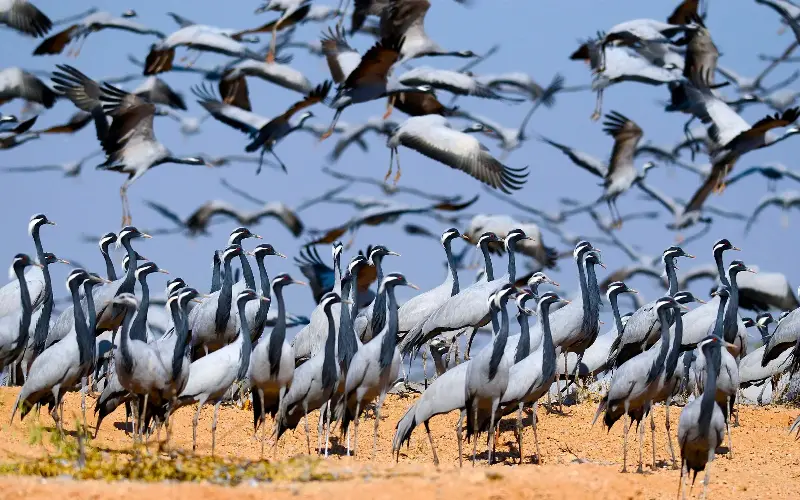
The small village of Khichan, in Rajasthan’s Thar Desert, has a unique tradition of feeding the thousands of demoiselle cranes that arrive every year on migration. These elegant birds complete an impressive journey over the Himalayas, flying south from their breeding grounds in Central Asia. At Khichan, more than 20,000 may gather in the nearby sand dunes before flying in to feed on the grain provided for them. Other rare wildlife in this little-known region includes leopards, striped hyenas and wild asses.
How to do it: Wildlife Worldwide offers a dedicated trip in search of north-west India’s rare wildlife, including the demoiselle cranes of Khichan, from £5,495 for 11 days, excluding international flights.
Asian elephants
Sri Lanka (July-October)
Every July to October, Minneriya National Park in central Sri Lanka hosts the world’s largest gathering of Asian elephants. As the dry season wears on, the elephants arrive from far and wide to slake their thirst at a large “tank” (reservoir) and crop the rich grasses left by its receding waters. Late afternoon offers peak viewing, as they emerge from the woodlands in family groups, eventually forming a mass congregation of up to 300. Other wildlife includes sambar deer, langur monkeys and abundant birds, with the ancient wonders of Sri Lanka’s Cultural Triangle a short drive away.
How to do it: Experience Travel Group offers a private guided trip to Sri Lanka, including a day in Minneriya, plus Wilpattu National Park and the Cultural Triangle. From £4,480pp for two weeks, including international flights.
Red crabs
Christmas Island, Australia (October-November)
From late October, a pincer-clicking army of crustaceans brings traffic on the Indian Ocean territory of Christmas Island to a standstill. This is the annual red crab migration, in which the start of the rains sees tens of millions of crabs leave the island’s forests and migrate to the beaches to breed, males arriving first to dig their burrows. These mass movements may block roads, and special passing places have been made to allow the crabs safer passage. Christmas Island, an Australian territory, also has impressive tropical seabird colonies and outstanding reef snorkelling.
How to do it: Australian Wildlife Journeys’ Christmas Island Ultimate Wildlife Tour takes in the red crab migration and other wildlife highlights. From £1,840 for eight days, including return air fares from Perth.
Wild geese
Norfolk, UK (November-February)
Britain provides a winter home to some 400,000 pink-footed geese, which migrate south every autumn from breeding grounds in Iceland and Greenland. A mid-winter evening on the Norfolk coast sees the skies fill with noisy honking as thousands commute in ragged skeins between roosting and feeding grounds. Other migratory wildfowl congregate nearby, including brent geese on the saltmarshes, while hen harriers and other wintering raptors join communal roosts. By April, the geese have departed, just as the spring migrants are arriving.
How to do it: Oriole Birding offers a three-night “wild goose weekend” in Norfolk that includes seeing the best of the pink-footed geese and the area’s numerous other migratory birds. From £745 for three days.