



Isca is a new restaurant at Borde Hill, in West Sussex, which draws both its inspiration and its crops from the surrounding garden. This is no plant-based fad. Borde Hill is a nearly 400-acre estate that dates back to the 16th century. The Elizabethan mansion that sits at the heart of its parkland was built by Stephen Borde – grandson of Andrew Boorde, a traveller, physician and writer of one of the first English health and diet books, who once, bravely, advised Henry VIII that his size and appetite were a danger to his health. Andrew was a plant lover and private herbalist to the King; Stephen shared his grandfather’s passion, establishing orchards as well as beds for medicinal plants in the grounds.
So when Isca lands – in a newly built conservatory at the edge of the estate, reachable in five minutes from Haywards Heath railway station – it merits respectful consideration. A local pal suggested we dine there. Genevieve played in the gardens as a child and there’s a tree, visible from the restaurant, under which she once lost a fight and a tooth.
I wondered at the meaning of Isca. It doesn’t stand for Islamic Supreme Council of America, nor the Institute of Singapore Chartered Accountants. No, fittingly, it’s a type of magnolia. And its dining room is a triumph. A grand palace of a conservatory, positioned at the head of the walled garden and set in handsome pale stone. The space is softened and sectioned by walls of plants and by sofas, curtains and columns.
There are window seats for two, cosy banquettes for more, larger spaces for big parties and a curved bar of wood and marble. You walk in and want to poke around and explore. I don’t know who designed the place, but if you need your airport cosying up, look no further.
We began with sips on the terrace. Genevieve had an exceptional margarita starring pickled magnolia and rhubarb, which tasted to me like a triumph of 50 years of experiments in blending booze with plants. I tucked into an Italian soave, and we munched charcuterie from Brighton-based producer Curing Rebels. Such is the quality of their curing (the coppa was magnificent), it’s another reason you no longer need to go abroad.
We had dinner indoors, choosing from a menu that tenderly delivers its inspiration from the garden – rather than shoving the concept laboriously down your throat. Even the ingredients act like artistic flourishes; words and phrases such as “lovage”, “watercress velouté”, “walled garden flowers”, “nettle” and “elderflower” leap joyfully from the page.
First, we were lobbed some freebies – tiny pastry cases filled with minute, fresh cuts of courgette, peas and sweetcorn, with the orange petals of Mexican marigold, and a cup of veggie gazpacho. Dainty, flavoursome beauties to swing the staunchest meat eater.
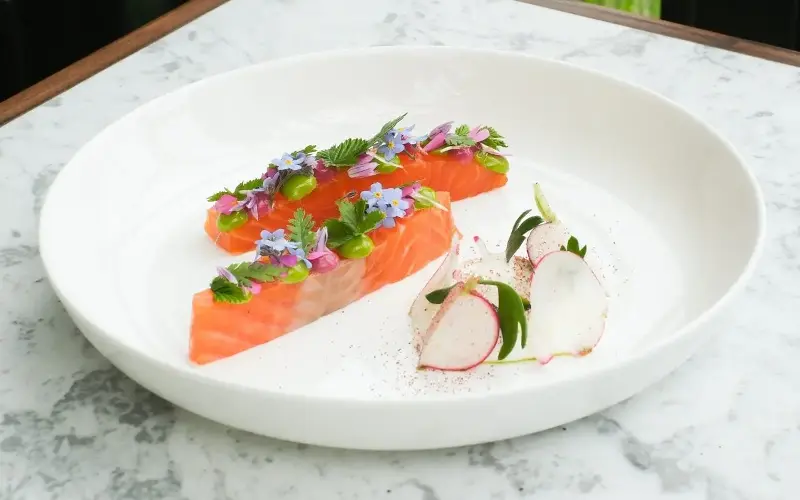
Then bread came, a heavenly cake-like mix of oats and treacle with whipped butter. Genevieve had cured trout with labneh, featuring a dazzling tweezering of those walled garden flowers along the top of the fish. It tasted as fresh and vital as the picture it presented. I dug deeper into the kitchen’s vegetative repertoire with a mushroom and malt tart.
My, that tart had such an intense and memorable flavour, the richness of the mushroom amplified by the earthy flavour of the flour used in the pastry, which is produced by a company called Hodmedod’s. At least I’m sure that’s what they said, and I asked them to repeat it so often I felt stupid. Still, even if the flour really is made by goblins, believe me, it’s good.
We shared a plate of monkfish, its meaty flesh still with some bite, served on a bed of soft and gorgeous white beans, with some bitter crunch from endive. On the side were crisp, pressed potatoes – simple but delicious – which completed a fabulous dinner of inventive cooking that respects the ancient lores of plants while serving them up in a wholly modern way.