



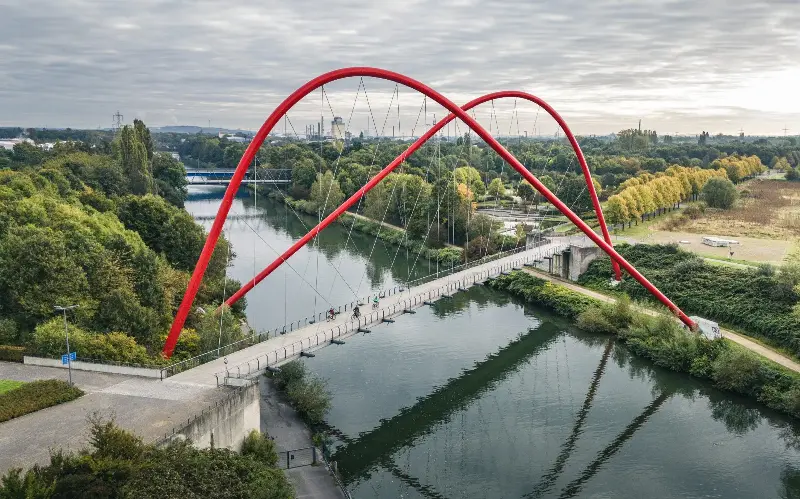
Not so long ago, a bike ride along the river Emscher would have been one of the least appealing excursions you could imagine. Not only was the river full of effluent, it ran through Europe’s biggest rust belt, the area that Germans call the Ruhrgebiet and Britons call the Ruhr.
During the last few decades, however, something extraordinary has happened. In the 1980s and 1990s, most of the Ruhr’s steel mills and coal mines shut down, and nature has since reclaimed those empty sites, burying redundant mills and mines beneath a sea of leafy saplings.
This industrial landscape has become a forest. It’s hardly paradise – at street level, there are still a fair few eyesores (empty warehouses, derelict factories) – but if you climb to the top of one of the old slag heaps and survey the view, the overriding colour is green, not grey.
The river Emscher has undergone the most dramatic transformation. What was once a lifeless waterway is now the home of swans, herons and kingfishers. Before, the river was artificially straightened so waste would flow through more rapidly. Now it meanders through broad floodplains. And, best of all, a footpath/cycleway runs along its winding route.
Like a sci-fi movie with a happy ending
The Emscher Weg hugs the bank of this resurrected river, covering about 63 miles. I rode all the way along it, from the Rhine to the source, with Jochen Schlutius, a local.
Not so long ago, the idea of a holiday in the Ruhr would have been laughable. Yet since the Ruhrgebiet turned green, it’s attracted lots of tourists – not only Germans, but lots of visitors from the Netherlands, and even a fair few Britons (Monty Don came here for his TV series Monty Don’s Rhineland Gardens).
Jochen led the way and I followed, cycling alongside this revived waterway on a smart new e-bike (a great way to travel, however fit, or unfit, you may be). I was amazed to see how lush and verdant this riverbank has become. Decaying industrial ruins made the route even more alluring, giving it a weird, futuristic ambience, like a sci-fi movie with a happy ending.
We ended day one in Oberhausen, once home to one of Europe’s largest steelworks. Now the site is an enormous shopping centre, with tidy rows of trees flanking an artificial lake. The only surviving relic of the old days is the gigantic Gasometer, now an atmospheric exhibition space. Aptly, the current exhibition, Mythos Wald (Forest Worlds, until Dec 30), is all about the beauty and fragility of nature.
How a dead river is brought back to life
From Oberhausen we headed east, and the Emscher began to narrow. It meant I could clearly see how a dead river is brought back to life: soften the banks, slow the flow and let the river go where it wants to go. Nature will do the rest. There were cyclists of all ages from toddlers to pensioners along the Emscher Weg – and none of them were were wearing Lycra. This isn’t just a tourist attraction, but a popular activity for locals, too.
We stopped for lunch (beer and a currywurst) in Nordstern Park, on the green edge of Gelsenkirchen. This place used to be a coal mine – the pithead wheel is still there. The surrounding site is now a landscaped garden, a laid-back rendezvous for families, teenagers and courting couples. It shows what can be done with old brownfield sites like these.
Jochen was born and raised here, and he’s quietly patriotic about the Ruhrpott (as locals call it). Nobody in their right mind would call it uniformly beautiful, but the discreet glory of the Emscher Weg is the way it zigzags along a nature corridor, sidestepping the worst of the remaining eyesores. Even where steelworks are still up and running, flora and fauna are now thriving. It shows that with careful planning, nature and industry can live side by side.
Lessons for Lancashire
I began my final day at Kokerei Hansa, an old coke-processing plant on the outskirts of Dortmund. It sounds like an improbable tourist destination, but this huge dystopian site was fascinating. Its rusting metal structures were like colossal sculptures. It’d be a great place to shoot a film or stage a play, I thought. Why do we revere ruined castles, not ruined factories? They’re equally impressive; both are memorials of the way we used to live.
Jochen met me outside and we cycled through Dortmund, down into the Emscher valley. In a way, this was the most impressive section of the route. Other parts of the Emscher are just as pretty – but seeing it looking lovely in the middle of a drab, humdrum conurbation was remarkable. You’d never guess the workaday city is often only yards away. We stopped beside Phoenix See, a big, broad lake where a massive steelworks once stood. I was astonished to learn that this vast lagoon is barely 20 years old.
Westfalenstadion, home of Borussia Dortmund FC, loomed above us, and then it was out into open countryside, that lurid yellow football stadium barely visible among the trees. We cycled on, through farms and fields, past an old pit shaft in a peaceful copse, two lovers lying beside it. It was like a scene from a romantic novel.
I didn’t think the source would amount to much, but it was utterly enchanting: a deep, dark pool in a shady glade beside a robust half-timbered farmhouse. It was wonderful to know that the entire river, previously so polluted, is now as fresh and fertile as this gurgling little spring.
As I headed for home, I thought of all the waterways in East Lancashire, a region that has a lot in common with the Ruhr. Like the Ruhr, it is an industrial powerhouse that fell on hard times when its mills and mines shut down. Like the Ruhr, it’s surrounded by splendid countryside. All it needs is new infrastructure to bring it back to life.
How to do it
William Cook travelled to the Ruhr with Eurostar and Deutsche Bahn via Brussels and Cologne. The nearest airports are Cologne-Bonn and Düsseldorf. For information about cycling the Emscher Weg, visit www.radrevier.ruhr. Allow two full days for the entire trip, or three days if you want to stop off at the industrial sites en route (details here). The best base is Heiner’s Parkhotel, a smart and modern four-star hotel in Nordsternpark, midway along the route and beside the river. For more information about visiting Germany, see www.germany.travel