



For some, the pinnacle of travel is to trek to Machu Picchu. For others, it is to witness the northern lights. We all have our personal globe-trotting “bucket lists”. But which is the greatest travel experience of them all?
To decide, Telegraph Travel first narrowed things down to 100 of the greatest experiences imaginable on Earth. These ranged from driving the Great Ocean Road to climbing Mount Kilimanjaro, witnessing the Galápagos to inter-railing across Europe.
We then sought the opinions of 50 widely travelled experts, asking them to rate each completed contender out of 10. After discounting those experiences that fewer than five writers had ticked off, we calculated averages to produce a definitive ranking.
A trend became apparent. It was clear that our planet’s most enjoyable travel experiences centred on natural wonders. None of our 22 shortlisted urban experiences (such as the temples of Kyoto and the ancient wonders of Rome) made the top 10. Instead, it was wildlife-spotting, scenic hikes and incredible landscapes that emerged victorious.
So here we have it, the top 10 travel experiences on Earth, according to the people who have made a profession out of exploring it. Do you agree? Please comment at the bottom of this article to share your thoughts.
10. Sailing through history: A Nile cruise
The debate as to whether the Amazon or the Nile is the world’s longest river has kept geographers in book sales for decades, but the question of the planet’s greatest river is much easier to answer. Simply, it is Africa’s incomparable waterway, flowing north from the highlands of Rwanda to its delta on the Mediterranean.
And to be specific, it is the 1,000 Egyptian miles of the river’s 4,400-mile journey that hold the prime place on the pantheon. While the scenery on either side does not change dramatically – alternating between lush tranches of floodplain and hard expanses of desert – the historical journey it provides is a story that every traveller should hear once.
Whether you embark on an epic odyssey from Cairo down to Aswan, and on to Abu Simbel, or focus on the “core” section of the Egyptian Nile around Luxor, the myths and legends arrive with astonishing regularity. Certainly the latter city’s power trio of the Karnak and Luxor temples, and the Valley of the Kings, are an unbeatable combination – all soaring columns, pharaonic tombs, and the ghost of Ramesses II at every corner. Add in a sunset cocktail on the upper deck at day’s end, and the picture is gloriously complete.
How to do it
An eight-night holiday to Egypt, featuring a four-night Oberoi Philae cruise from Luxor to Aswan, and time in Cairo (for tours of the Grand Egyptian Museum and the pyramids), starts at £6,949pp, including flights and transfers, with Audley Travel.
Chris Leadbeater
9. The rail deal: A ride on the Venice Simplon-Orient-Express
There is something supremely theatrical about a journey on the Venice Simplon-Orient-Express (VSOE). The set – a glorious ensemble of Lalique glass panels, polished marquetry and Art Deco style – is a work of pure joy; the cast – from liveried bartenders to suavely attentive stewards – plays its part to perfection; the scene changes – from city lights to misty meadows and snow-capped peaks – are backdrop nirvana.
The VSOE is a sublime restoration of the Orient Express, the train that epitomised the golden age of travel. While it occasionally follows the original routing across the continent to Istanbul, its signature journeys – especially the classic Paris-to-Venice run – are more compact affairs.
It is true that it is eye-wateringly expensive. But if you can afford it, it is an experience you will never forget: a journey to another, grander world. So get into character and dress to the nines. Saunter to the bar car and ask for champagne. Clink glasses and drink in the moment. Then raise a toast to the most fabulous train in the world.
How to do it
A berth on the Venice Simplon-Orient-Express for the two-day, one-night Paris-Venice journey costs from £3,885pp in a Historic Cabin or £8,785pp in a suite.
Adrian Bridge
8. On top of the world: Hiking in the Himalayas
When I first laid eyes on the Himalayas, 30-plus years ago, it was love at first sight. After arriving at Pokhara in darkness, I was floored by my first glimpse of Nepal’s parade of peaks the following morning. Dauntingly tall, the Annapurnas loomed above, filling the horizon, rendering me speechless.
Despite their colossal size, these mountains aren’t unattainable. True, I won’t be scaling any 6,000m-plus peaks (well more than 1,000 of which scrape Himalayan skies). But hiking among them has provided perhaps the greatest thrills of my travelling life – most recently tackling the Manaslu Circuit, a spectacular but little-tramped alternative to the busy Annapurna loop.
I traversed monkey-thronged bamboo forests and Tibetan-style villages, hiked beneath rainbow prayer flags and past Buddhist temples, crossed yak-munched meadows and breath-snatching passes. I inhaled intoxicatingly fresh mountain air, spiced with pine needles and incense, and swooned over the flash as the rising sun caught the twin peaks of 8,163m (26,781ft) Manaslu, the “Mountain of the Spirit”. Trekking Nirvana.
How to do it
Mountain Kingdoms offers a wide range of Himalayan hikes; the 18-day Manaslu Circuit holiday costs from £2,175pp excluding flights.
Paul Bloomfield
7. The really wild show: An Okavango safari
First, it is the richness and variety of the Okavango landscape that makes it a 10/10 for me: parched white salt pans; tall, slender palm trees that dwarf passing giraffes; vast pewter skies above bronze grasslands cleaved by winnowing winds; water meadows, lush as rice paddies; pools and wallows filled with floodwater, pushed out in a rippling bow wave by a Land Cruiser adapted for amphibious life.
The scenery is bewitching, and no other location I’ve visited has delivered so many wildlife encounters. In a week, I ticked off 97 species, from lions stalking warthogs to hyenas, jackals, elephants, a pregnant leopard and a pangolin – so rare most guides hadn’t seen one in 20 years. Another plus? On the delta’s private concessions, off-road driving and night safaris are permitted, while the number of vehicles at any gathering is limited to three or four compared with dozens in a national park or reserve.
How to do it
Naturetrek’s 10-day Botswana’s Desert & Delta safari costs from £4,695pp including flights.
Andrew Purvis
6. Endless desert: The Namib
There is desert. And then there is the Namib. On and on and on it ripples, in sensuous apricot curves so perfectly sculpted it seems a shame to leave footprints. The Namib is one of the oldest and most enormous arid expanses in the world, a place so vast and apparently indifferent to human advances that it makes you feel as insignificant as one of its centillion grains of sand: a humbling effect that’s intensified after dark, standing under the starriest skies you’ll ever behold.
With their bright-white clay pans and gargantuan dunes, Sossusvlei and Deadvlei steal the show. They are best photographed just after sunrise and just before sunset, when the light isn’t too harsh. But I loved the Namib’s damper, less-trodden edge even more: the limestone and dolomite mountains of the Naukluft Massif, which rear from the desert plains, a playground of rugged gorges, clear springs, hidden rock pools, klipspringer, black eagles – and no other people.
How to do it
Expert Africa offers a 14-night southern Namibia self-drive safari, strongly focused on the Namib, from £3,180pp including mixed-board accommodation and car hire, excluding flights.
Sarah Baxter
5. Wide open space: Escaping the crowds in Mongolia
Mongolia rewires your sense of space. Larger than Western Europe, it’s one of the last great frontiers – where horses outnumber cars five to one. Around a third of its 3.5 million people still live nomadically, and travellers can stay with families in traditional gers scattered across the grassy steppe, welcomed with suutei tsai (salty milk tea), airag (fermented mare’s milk) or even an impromptu performance of khoomei throat singing.
Ride two-humped Bactrian camels across the Gobi Desert, explore the Flaming Cliffs where dinosaur eggs were discovered, meet Kazakh eagle hunters, or time your trip for Naadam – the ultimate showcase of wrestling, horse racing and archery. Mongolia reminds you what a tonic big skies and unfenced horizons can be.
How to do it
Goyo Travel – run by a British-Mongolian couple, Oliver and Goyo Reston – offers a 15-day Nomadic Elements tour from £3,070pp.
Emma Thomson
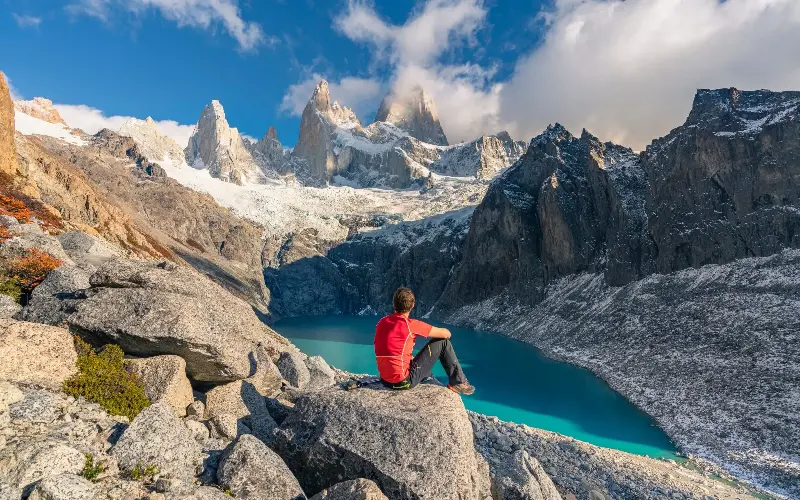
4. Perfect peaks: Trekking in Patagonia
In a world that often feels overpopulated, nature-bereft, spiritually void and just plain ugly, Patagonia is a merciful release. Hardly anyone lives there, and there’s vast emptiness between the main towns. The coasts are glistening wonders filled with birds and whales. The Andes are snow-capped and glacier-hoarding. The steppes and pampas are expansive. The sky is huge, vaulting the imagination.
A drive down Argentina’s Ruta 40 or Chile’s Southern Highway is to be undertaken slowly. In the Welsh Valleys of Chubut, stop at the chapels to pray and ponder. In Ushuaia and Punta Arenas, maritime, indigenous and natural history come alive.
But the god of Patagonia is also the god of walkers, to adapt a remark of Bruce Chatwin’s, and the most rewarding way of getting to know this wild, beautiful corner of the planet is to don a rucksack and sturdy boots and step out into Torres del Paine, Los Glaciares National Park, the bosky mountains around Bariloche and Lago Puelo – or, frankly, anywhere there’s a track, some shade and a place to camp.
How to do it
Patagonia is best in spring or autumn. Journey Latin America’s 12-day Charito: Pure Patagonia tour to Chilean Patagonia starts from £3,685pp, excluding flights.
Chris Moss
3. Like nowhere else on Earth: The animals of the Galápagos
Few places in the world can be described as unique – except, perhaps, this volcanic archipelago off the coast of Ecuador, which changed the course of modern science.
It’s not just the insouciant land creatures you expect to see – the brilliant blue-footed and red-footed boobies, the Galápagos giant tortoise and Darwin’s “imps of darkness”, marine iguanas, shimmering in their chain-mail coats and Mohicanned from nape to tail – but the unexpected encounters. The Galápagos is matchless in its ability to surprise. Look away for five minutes, and you might miss orcas, a Galápagos hawk or the perplexing sight of a shower of boobies plunging to the sea.
Underwater, creatures are as curious, feisty and fearless as they are on land. The wiry whiskers of fur seals grazed my snorkel mask, penguins spun me in storms of bubbles, and turtles eyeballed me. I have never felt as happily discombobulated anywhere in the world.
How to do it
A 14-day, Wildlife of Ecuador and the Galápagos trip, featuring three nights in the Ecuadorian Amazon and a week’s cruise on an eight-cabin motor vessel in either the Eastern or Western Galápagos, costs from £7,615pp including flights with Wildlife Worldwide.
Teresa Machan
2. Going ape: A close encounter with mountain gorillas
Your guide ushers you forward and you crouch down quietly, as bidden. It feels awkward, like entering somebody’s sitting room uninvited. But the apes are oblivious. They’re enjoying their siesta, hillocks of black fur scattered among the glossy greenery. Your heart is pounding, both from the climb and the adrenaline: Can you really be this close to wild mountain gorillas?
After the first obligatory photos, you settle back to drink it all in: the nursing mother shielding her infant; the tumbling youngsters; and the formidable silverback, who finally sits up to check you out, revealing mountainous shoulders, beer-bottle fingers and a gaze of unnerving intelligence.
Yes, your precious hour may be short on action. But action isn’t the point. Being amongst these awe-inspiring creatures in their forest home as they simply do their thing is an extraordinary privilege. You just sit and marvel.
How to do it
Volcanoes Safaris offers an all-inclusive seven-night gorilla-trekking holiday, including treks in both Uganda and Rwanda, from £7,495pp.
Mike Unwin
1. Frozen planet: A voyage to Antarctica
Before you arrive, there are the clues. The electric blue “growlers” (miniature icebergs) floating in the water. A raft of penguins, dipping and diving alongside your ship. And then, finally, after two days at sea, you get a first glimpse of Earth’s last great wilderness: Antarctica.
More than 50 cruise operators run trips to the Antarctic Peninsula, ranging from luxurious vessels with helicopters and on-deck pools to smaller expedition yachts. However you sail, the same epic Antarctica awaits. This is a land of ornamental icebergs. It is a world where avalanches boom around sheltered bays, where leopard seals lull in the summer sun, while penguins – gentoo, Adélie and chinstrap – pinch stones from each other’s rock nests.
Some say travel to Antarctica is an indulgence too far. In the modern era, however, Antarctic ships are cleaner than ever, including a growing fleet of hybrid vessels, and excursions are well managed thanks to closely guarded IAATO regulations.
Eleven of Telegraph Travel’s 50 judges have travelled to Antarctica. Eight gave the experience 10 out of 10, while three gave it a nine. With an average score of 9.7 it is, without dispute, the world’s ultimate travel experience. A pleasure, a privilege, and the closest you can get to an interplanetary experience without leaving Earth’s orbit.
How to do it
HX Expeditions offers a range of Antarctica itineraries. The 12-day Highlights of Antarctica trip starts from £7,238pp, on an all-inclusive basis.
Greg Dickinson