



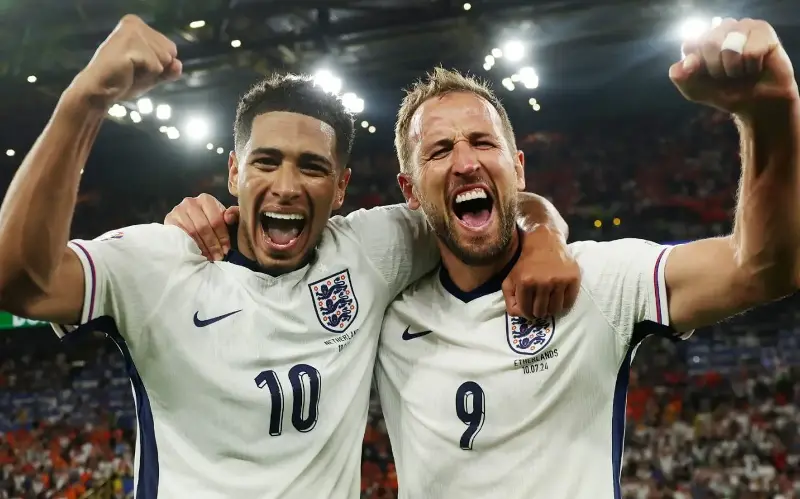
Thomas Tuchel’s stated mission is to add a second star to England’s shirt by winning the World Cup for the first time since 1966.
The men’s team have not won a major tournament since that triumph on home soil, losing the last two European Championship finals in agonising fashion.
Defeat by Japan was sobering but England will travel to North America with a squad stacked with talent, and a head coach who is a Champions League winner with a decorated CV.
A group containing Croatia, Ghana and Panama looks relatively benign, although things could get trickier from there with a quarter-final against Brazil a possibility.
Telegraph Sport has picked out six reasons to believe that, after 60 years, football is finally coming home.
1. Tuchel’s cup record
The German shook off Paris St-Germain’s Champions League hoodoo, guiding them to the final, before winning the tournament with an unfancied Chelsea team a year later in 2021. He has won the German Cup, French Cup, Fifa Club World Cup and Uefa Super Cup, and was unfortunate not to win a League Cup with Chelsea when beaten by Liverpool on penalties in 2022.
As Bayern Munich head coach for the 2023-24 season, Tuchel navigated a way past high-flying Arsenal in the Champions League before losing to a last-minute goal against Real Madrid in the semi-finals. In the Bundesliga, though, Bayern were well off the pace and finished third, 18 points behind Bayer Leverkusen.
If anything has proved Tuchel’s undoing it has been a failure to secure enough league wins over a season and falling out with people over transfers. Neither are England’s concern at a five-week tournament. He is very canny in his approach to one-off games.
2. Battle-hardened squad with tournament experience
Wayne Rooney and Lamine Yamal lit up tournaments as teenagers but successful international teams tend to rely on an experienced core of players. Scrutiny is intense, preparation time limited and legs can be heavy; players need to be self-sufficient on and off the pitch to cope with all that a summer tournament brings.
The most-used XIs of World Cup and European Championship winners since 2010 have had an average age between 25.9 and 28.4 years, with Portugal’s functional Euro 2016 winners the oldest. Based on an educated guess of Tuchel’s most-used starting XI, this summer England’s average age would be a healthy 26.5.
By the time the tournament kicks off the youngest player will be 21-year-old left-back Lewis Hall and the eldest will be Jordan Pickford, John Stones and Harry Kane at 32. So England’s average age is not being inflated by an elder statesman or pushed down by a raw prospect. This is a team packed with players in their prime years.
In fact, this England XI would have the highest average caps per player of any World Cup and Euro winners since 2010 at 51.8. Elliot Anderson and Hall would be the only players with fewer than 20 international caps.
The picture could change by the summer. Stones has suffered a litany of injuries, and any absence could push Tuchel to name a greener centre-back pairing. However, England could be even more experienced in other positions if Luke Shaw proves his fitness at left-back or Jordan Henderson is considered in midfield. The possibility of Reece James, Stones and Shaw all being fit to start appears unlikely, so our prediction of James, Stones and Hall in those positions should be a fairer estimate.
The majority of England’s squad can call upon the muscle memory of reaching finals in two of their last three tournaments. Jude Bellingham and Kane play for Real Madrid and Bayern Munich. Declan Rice and Bukayo Saka have more Champions League knockout experience with Arsenal than they did in 2024. Marc Guéhi, considered untested at the Euros, has since won the FA Cup with Crystal Palace and moved to Manchester City.
3. Set-piece potency
Dead-ball situations have been one of England’s traditional strengths: think Paul Gascoigne teeing up David Platt’s sumptuous volley, David Beckham’s delivery or Harry Maguire and the “love train” at the 2018 World Cup. Let’s not start on the disallowed Sol Campbell goals from corners against Argentina in 1998 and Portugal in 2004.
This prosaic route to goal has been refined for the modern age in the Premier League this season, with 27.22 per cent of goals in the top flight coming from non-penalty set-pieces.
If possible, set-piece goals could be even more important at an international tournament. Coaches do not have a pre-season packed with double sessions to orchestrate intricate patterns of attacking play. It is easier to drill defensive shape at short notice, as demonstrated in the Premier League where out-of-possession coaching has never been better. Games could be played in punishing heat on slow pitches, with three-minute hydration breaks in each half. Do not be surprised if the football is bitty.
Set-pieces are an avenue for quick wins, and to progress in the tournament with an economy of effort. Gareth Southgate and Steve Holland fostered the culture of taking set-pieces seriously, with nine of England’s 12 goals in their 2018 World Cup semi-final run coming from dead balls. Penalties included, 43 per cent of goals in Russia were set-piece goals.
Tuchel has already identified set-pieces as an area of focus, and with Rice, Saka and James, England should be menacing from these situations. Maguire has had a better campaign with Manchester United and could even be used as an emergency attacking substitute. The importance of dead balls could inform the second striker Tuchel takes to the tournament behind Kane; the aerially strong Dominic Calvert-Lewin was preferred in England’s March squad.
England’s goal against Uruguay was scored by Ben White from a corner, and they only started to threaten against Japan once Maguire and Dan Burn were on the pitch.
4. Problem positions solved
There were two holes in England’s team at the Euros: the lack of a left-footed left-back and an adequate partner for Rice in central midfield.
Southgate started the tournament with Trent Alexander-Arnold in a conventional midfield role, rather than allowing him to drift inside from right-back, but that plan was ripped up after two games. Conor Gallagher started the third game, before Kobbie Mainoo kept his place for the rest of the tournament.
Mainoo’s form since he was restored to the Manchester United team by Michael Carrick puts him back in the conversation, but Anderson is in pole position to start this summer. The Nottingham Forest man has been impressive in his England appearances so far, and has put up some eye-catching underlying numbers in a struggling side.
There are some rough edges to Adam Wharton’s defensive game, but he offers Tuchel a different option and balance as a left-footer. Wharton’s ability to control the ball on his back foot and play incisive forward passes in one fluid movement marks him out as a rare English talent.
At left-back, England’s build-up play was hampered at the Euros by the deployment of the right-footed Kieran Trippier. This issue was exacerbated by the decision to play Phil Foden in a roaming role from the left flank, meaning there was no natural width on that side.
While no player has the position locked down, Tuchel at least has better options. Shaw has been a regular starter again for United, and offers final-third quality and a relationship with Marcus Rashford who could be England’s starting forward on the left. The same goes for Hall and Anthony Gordon should Tuchel combine the Newcastle team-mates.
Myles Lewis-Skelly looks to have slipped down the pecking order with opportunities limited at Arsenal, and Nico O’Reilly could profit. The 21-year-old switches between full-back and a midfield role alongside Rodri for City. If Tuchel wants a full-back who can invert into midfield, as well as attack on the outside and arrive late in the box, the precocious O’Reilly will be at the front of the queue and he got the nod against Japan.
5. A fresher Harry Kane?
Kane is enjoying the best goalscoring season of his career with a frankly ridiculous 48 goals in 40 appearances in all competitions for Bayern. Fifteen of those goals have come from the penalty spot, but with the business end of the season still to come, Kane could end the campaign with a Ronaldo or Messi-esque tally of goals.
The numbers do not tell the full story of Kane’s growing influence on Bayern, who have strong claims to be Europe’s best team. Kane is a big NFL fan, and at times under Vincent Kompany he has played like a quarterback, dropping into his own half to spray passes forwards to Luis Díaz or Michael Olise.
Nobody questions the quality of Kane’s distribution, but the effect on England’s attacking balance when he drops deep has been a bone of contention at previous tournaments. When paired with the penetrative runs of Raheem Sterling or Rashford, it has worked well. Less so when another ball-to-feet player like Foden was shoe-horned into the team at Euro 2024.
It is an open secret that Kane struggled with a back injury at Euro 2024 when his movement was inhibited, but it was not the first time England’s captain has looked leggy at a summer tournament. The hope will be that after another season in Germany, in an 18-team league with a winter break and one domestic cup competition, Kane will be fresher. Tuchel is mindful of this, with his captain part of a group of 11 players who joined up late to the March camp because of their accumulated minutes. Kane’s absence against Japan because of a minor knock continued this policy of caution.
6. Abundance of creative talent
Previous England teams have been accused of playing “Subbuteo football”; positioned in straight lines in rigid systems with a shortage of players who could receive the ball in tight spaces.
Times have changed, and England now have an abundance of players who can offer flair and fantasy between the opponent’s midfield and defence. In fact, one or two high-class creative types will be disappointed because Tuchel cannot fit them all in.
Bellingham, Palmer, Foden, Morgan Rogers and Eberechi Eze are all pushing for a spot in England’s team as a No 10 or a roving role from the flank. All offer different attributes: Bellingham, late arrivals in the box and clutch goals; Palmer, defence-splitting passes; Foden, dexterity on the half-turn and dribbling; Rogers, long-distance carrying; Eze, pure ball-striking with both feet from the edge of the area.
Palmer and Foden started against Japan in central positions and failed to seize their chance, with Tuchel downbeat in his assessment of the Man City man.
Tournament football can be a slog, and as the competition progresses the margins that separate winning and losing will get smaller and smaller. A moment of individual brilliance can be the difference, such as Bellingham’s overhead kick which spared England an embarrassing exit to Slovakia two years ago.
England have no shortage of players who can deliver flashes of inspiration; it is a matter of Tuchel deploying the right one at the right time.