



When the 25-year-old Habsburg Archduke Karl Stephan was sailing around the Adriatic in 1885 looking for the perfect spot to relax from his imperial duties, he fell in love with the island of Losinj. It had, he felt, everything: a remarkably pleasant climate, a beautiful landscape and dense, aromatic vegetation that scented the evening air. Even more senior members of the family followed – Emperor Franz Joseph and Empress Elisabeth and that ill-fated pair, Crown Prince Rudolf and Archduke Franz Ferdinand. Villas were built on a suitably palatial scale along the shoreline, and the Habsburgs and their courtiers were ensured a serene escape from the harsh Central European winters.
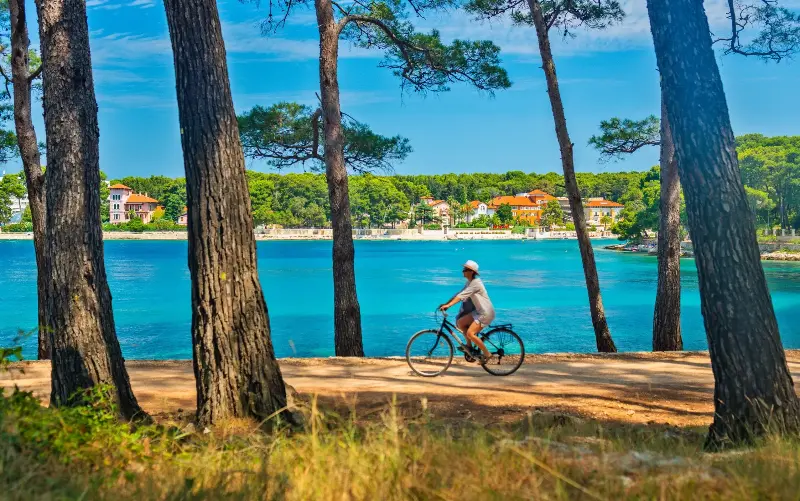
Sipping a chilled Istrian wine at the charmingly rustic Lanterna restaurant in Cikat Bay, it feels as if little has changed since Karl Stephan’s day. The forest still reaches down to touch the shoreline. The dolphins frolic as delightfully as ever in the warm Adriatic water. And the sun drops gracefully into the sea to bring just the right touch of drama to the evening sky.
In fact, some things have changed, perhaps even for the better. There is actually more forest now than in the Archduke’s time, as the scientists and climatologists of the late 19th century didn’t just recognise Losinj’s unique health benefits but decided to improve upon them. So, in 1887, a process of afforestation began that in its first year saw the planting of more than 80,000 Aleppo and Scots pine trees. Half a million more were planted in 1891 and, a year later, the island was officially declared a natural health resort.
Visitors arrived to recover from illness, especially (this being the era of tuberculosis) from consumption. What they found was a combination of abundant sunshine (around 2,600 hours a year) and pure sea air, heavily enriched with the aromatic oils of 1,200 native plant species, as well as all those pines. Together, they produce a natural aerosol that, when inhaled, relieves respiratory diseases and allergies, and expands lung capacity. This was good news for the Habsburgs, who suffered from weak lungs.
Losinj is still known as the Island of Vitality and, while some people do come for their health, most visitors are now here for the sheer beauty of the place. Nature lovers hike, bike and camp in the abundant forest, while sun worshippers lounge on the beaches and swim in the warm, clear waters of the Adriatic.
There are pretty towns and a museum dedicated to the Apoxyomenos, a bronze statue of a young athlete that was taken out of the sea in 1999 after nearly two millennia, having been found just off shore by a Belgian tourist on a diving trip.
There are splendid restaurants – the Alfred Keller in the Alhambra Hotel has a Michelin star and Matsunoki in the Hotel Bellevue offers fine Japanese dining. Several of the Habsburg villas around Cikat Bay have been restored by the Bellevue to beyond their former glory with marble bathrooms, Venetian chandeliers, and chefs, butlers and gardeners at your very exclusive service.
It’s all still fit, then, for an emperor – but you don’t need such a rarefied background to appreciate this island. Walking back from the Lanterna at dusk, the air is a heady mix of sea salt, pine and lavender, jasmine and gardenia. With the sea on one side and the forest on the other, the path is lamplit at dusk, winding its way along the shore, a Narnia of the warm South.
Despite its obvious charms, somehow, Losinj remains unspoilt and uncrowded. This is, perhaps, not that surprising because, from the airports of Zagreb or Pula, you have a drive and a ferry and another drive before you arrive in arguably the island’s loveliest spot, Cikat Bay. You can, of course, get a private plane from Split or Venice as there is an airstrip on the island. This is hardly going to result in mass tourism, though, which Losinj has thankfully withstood over the years.
So, 140 years on, much remains the same. The air is as pure as ever and, some say, it’s the healthiest on the planet. Certainly, the island’s health benefits endure. At the Hotel Bellevue, a coolly contemporary five-star Italianate space, you can even take the Seatox cure. A combination of oily relaxing massages and hi-tech treatments with marine-based therapies to complete the detox, they still count on the air for maximum results. My first session, in fact, was sitting in the early morning sunshine on a jetty while personal trainer Marin ran me through a series of breath exercises, and I obediently inhaled all those therapeutic aerosols.
Who wouldn’t feel well on this lovely island? All you have to do is breathe.
Essentials
A seven-night stay at the Hotel Bellevue (in a Superior Double Room on a B&B basis) starts from £1,434 per person, based on two sharing, including transfers (car and ferry from Pula Airport) and return flights from the UK.
Wellbeing Travel offers the Seatox Programme at the Bellevue from £4,030 (or £4,685 with a private flight transfer from Pula to Losinj). The Bellevue’s villas cost from €14,000 (£12,130) per night, including personal butler, daily breakfast, housekeeping and private transfers to Losinj Airport.
For further information on Croatia and its islands, see croatia.hr