



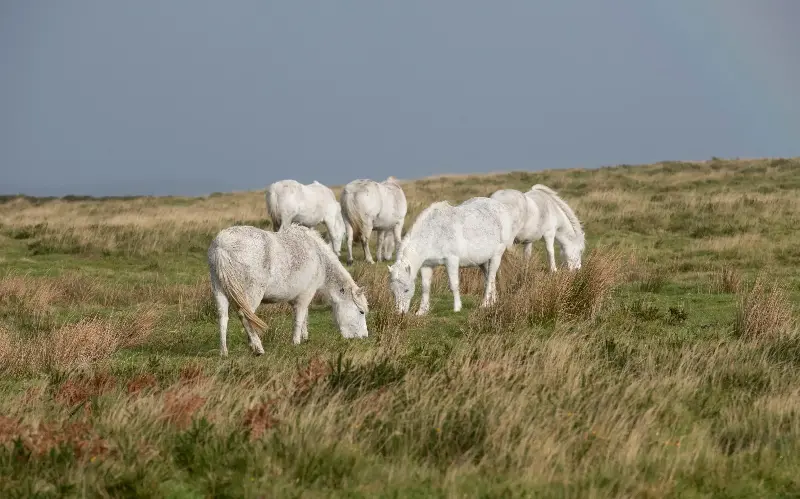
Dartmoor National Park’s ponies are at risk from environmental rules, campaigners have claimed.
The endangered semi-wild ponies, the responsibility of the area’s Commoners, have roamed Dartmoor for more than 3,500 years.
While environmental schemes have restricted the amount of livestock Dartmoor’s Commoners – farmers whose animals live on the moorland – are allowed to graze since 1994, the ponies have never been affected.
However, they are now expected to be included for the first time in restrictions set out by the Department for Environment, Food and Rural Affairs (Defra) and Natural England.
The new proposals ask Commoners to cull their livestock by 75 per cent, and campaigners fear that could mean up to 93 per cent of the 1,000 ponies are removed to make more room for commercial cattle-grazing.
Campaigners fear most ponies rounded up during the annual October “drifts” would be culled. The “drifts” see farmers round ponies up into pens for health checks.
Charlotte Faulkner, the chairman of the Friends of the Dartmoor Hill Pony group, said: “In all previous schemes, the ponies have run in the background. They’ve not been included in the grazing density numbers for cattle and sheep. Now they are.
“So two things are happening. Farmers have to reduce their livestock by 75 per cent, and they have to include ponies. So the ponies have to compete with commercial livestock – they’ll always be the first to go.”
Over-grazing can damage the biodiversity of moorland, including making the land unsustainable for future livestock. Defra has ordered farming communities on moorlands across the country to limit the grazing density of their livestock for more than three decades.
However, the Commoners claim the government is misunderstanding Dartmoor’s environmental life.
Ms Faulkner said: “These ponies have been here since the Bronze Age. They’re one of the nearest things England has to wild. There would be irony if, in the name of rewilding, we lost the one wild thing we’ve got. Leave them alone.
“There’s a lack of coordination between Natural England and DEFRA. On one list we have to write a breeding programme, they’re endangered. On the other list, we’re being asked to shoot 75 per cent of them.”
There are now fewer than 1,000 Dartmoor hill ponies now, down from around 7,000 in 1999, according to the Dartmoor Hill Pony Association.
Uniquely adapted to the moor’s marshy terrain, the breed was added to the Rare Breed Survival Trust watchlist in 2023. They are one of England’s last semi-wild pony herds, with other wild pony breeds found in nearby Exmoor and in the New Forest.
A petition to protect Dartmoor’s ponies from the new plans has gained more than 17,000 signatures.
Sarah-Jane Norris, a campaigner who began the petition, wrote: “Natural England is failing Dartmoor. Dartmoor’s semi-wild hill ponies are recognised as rare and endangered, and should be protected as such.
“Reducing pony numbers further means that the population will no longer be genetically viable and will effectively become extinct.”
Robert Jordan, a member of Dartmoor Pony Society, whose family has farmed in the area since 1913, said: “The ponies, over the years, have been under threats from many different things in many different ways. But they’re very resilient, and I will do my utmost to make sure they’re protected.
“It’s fair to say that on the traditional farms around here, the ponies are generational and so are the people – they’re tied together.
“Here at Dartmoor we’ve been in environmental schemes for nearly 30 years. We’ve done all the grazing prescriptions we’ve been asked to, but Natural England still wants to reduce livestock numbers.”
Dartmoor has been under siege for several years by environmental pressure groups blaming overgrazing and poor land management for a decline in biodiversity on the moor.
Chris Packham, BBC presenter and campaigner, successfully campaigned for a judicial review against the Dartmoor Commoners’ Council last year. He claimed the council failed to enforce controls on grazing and the number of livestock.
In March this year, a High Court judge ruled that Dartmoor Commoners’ Council had failed to assess the number of livestock grazing on the moor.
A Defra spokesman said: “In line with the independent review of protected site management on Dartmoor, we are working with partners, including the Dartmoor Hill Pony Association, to help ensure that we maintain numbers of semi-wild ponies on the Moor for generations to come.”