



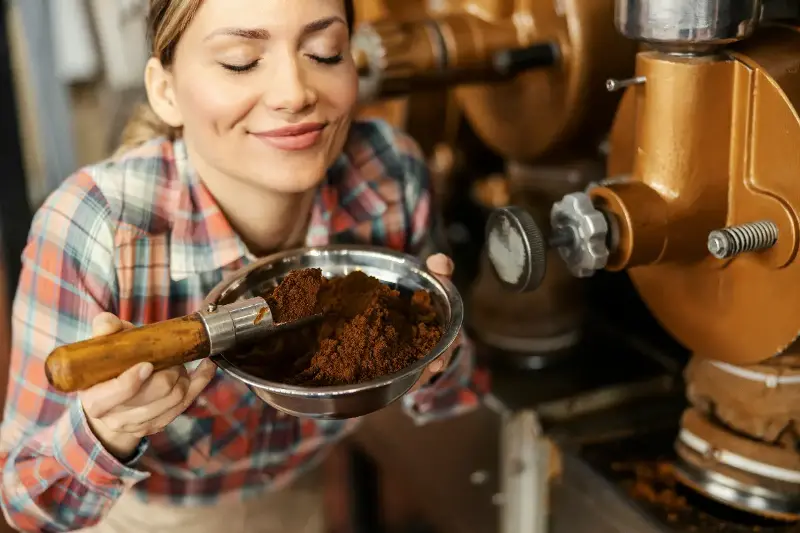
The secret to the perfect cup of coffee is not in making sure you use expensive or rare varieties, but in perfecting the art of bean grinding, a study has found.
Supermarket coffee can be made to taste as good as exotic roasts sold by baristas by grinding the coffee to grains as thick as a human hair, scientists say.
A study has found that the most important factor in determining whether a shot of espresso tastes good is how coarsely the beans are ground.
Grinding coffee too fine can make it bitter, they say, but not grinding it enough leads to a weak brew.
The ideal middle ground allows enough water to flow through the coffee puck, made from ground beans. The study suggests that, for water passing through the puck for 30 seconds, the coffee needs to be ground to grains between 145 and 275 micrometres in size. A human hair is around 180 micrometres thick.
Key is getting grain size right
“You can make an excellent cup of coffee with beans bought from the supermarket – the number one thing is getting the grain size right,” said Prof Fabian Wadsworth, from Ludwig-Maximilians University in Munich, told The Telegraph.
“A lot of people say that certain beans aren’t good, but I’m saying that if they got the grain size right, they could still make a perfectly satisfactory cup of coffee.”
Analysis found that coffee particles were rougher than previously thought and therefore water flow was a much more important element of brewing.
But Prof Wadsworth said this was a hard thing to do as every notch on a coffee machine exponentially increases water flow.
Researchers in Germany and at Lancaster University measured how quickly hot water flows through a serving of espresso coffee.
A Rwandan and a Colombian variety of coffee was ground 11 different ways and packed into drinking straws and tamped down to compress the grains.
The straws were then placed into a specialised X-ray machine that scans them from different angles to create a 3D reconstruction of the inside of the coffee samples that the scientists could “fly through” on their computer.
A computer simulated the flow of water through the channels between the grains to predict exactly how this would make a coffee taste.
A complex equation was created revealing the intricate relationship between water flow, grind type and taste.
The equation reveals that the desired speed of water flowing through the coffee puck should be about half a millimetre a second.
“The number one thing you’re aiming for with espresso is even flow of water through the puck,” Prof Wadsworth said.
“If you achieve even flow, you are well on your way to making the perfect cup of coffee,” he added, while the roast of the beans themselves is more a “matter of personal preference”.
Prof Wadsworth said that a coffee ground too coarse would not have enough time for water to extract flavour from the beans and be sour, but there was also a “point of no return”. This is when the grind is too fine and pressure builds up, leaving water overly exposed to the coffee and producing an overly bitter or burnt-tasting end product.
The study, published in the journal Royal Society Open Science, also revealed other tenets of coffee-making were less useful than previously thought.
For example, the elaborate ritual of levelling off their ground puck and then pressing it with a “tamper” was far less important than water flow.
Prof Wadsworth also said that not using boiling water was key, as water between 90 and 96C was the ideal heat for a good brew.