



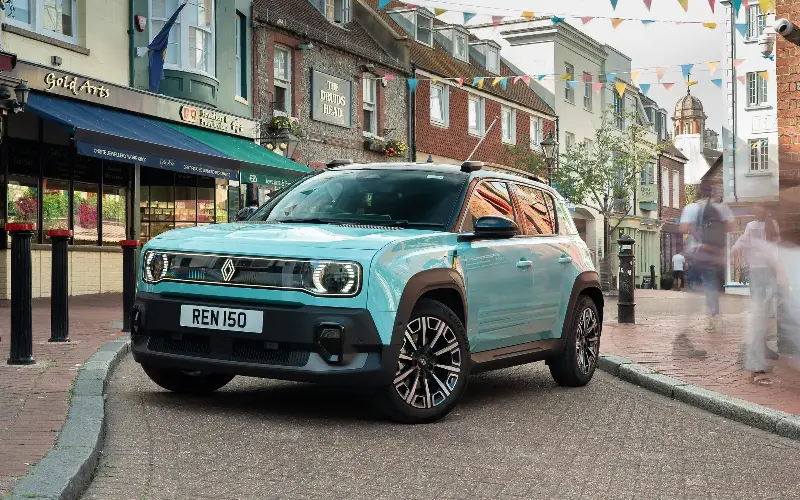
How can you not fall in love with this car at first sight? Critics may say that it’s a shameless rip-off of the original and that Renault should innovate rather reinvent its back catalogue. However, in a sea of grey, identikit SUVs, doesn’t the 4 look great?
So delightful are the myriad neat design touches – the reverse-rake rear window, the dainty rear lights, the creases pressed into the lower door panels – that you find yourself willing to forgive it plenty.
Can you forgive the fact it’s an SUV, though, when the original was but a simple hatchback? Yet the new 4 is only 8cm taller than the original; for all its plastic cladding and roof rails, it’s barely an SUV at all.
Pros
- Instantly beguiling styling
- Smart, tactile interior
- Slick touchscreen and useful physical controls
Cons
- Average-sized boot
- Quite cramped in the back
- Ride can be jostling
Four’s a charm
Put simply, the 4 is an attempt to sell the retro cachet of the 5 to a buyer who needs more space in the back, the better to suit small families. The 5’s rear seats and boot aren’t unusable, but neither are they ideally suited to child seats and pushchairs.
At 4.1m long, the 4 is still a small car; its main rivals are the Ford Puma Gen-E and the upcoming Volkswagen ID.2. However, the 4’s somewhat limited 420 litres of luggage space can’t match the Puma’s 523-litre boot.
It’s a similar story in the back seats, where the 4 is fine, but no more; given that this car is sold as the family-friendly alternative to the Renault 5, you might expect a greater difference between the two.
The stylish rear window proves to be problematic in day-to-day use, too; it demands a door shape that draws to a point at its trailing edge, at chest height – with occasionally painful results if you aren’t careful.
The 4 has the larger of the two battery options available in the 5; that gives an official range of 247 miles, which will equate to just shy of 200 in the real world. While that dictates stopping to recharge on longer journeys, it’s a greater range that you’ll achieve in most small EVs.
Charging rates peak at 100kW but average around 75kW across the whole charging curve (versus 85kW in the Puma), so it will take at least 31 minutes to charge from 10 to 80 per cent – adding about 120 real-world miles of extra range. Its energy efficiency, meanwhile, is also fine, but not exceptional, at 4 miles per kWh (mpkWh).
Inside story
While the interior isn’t as roomy as you might hope, it is rather lovely. The basic architecture is lifted almost wholesale from the 5, with a similar mix of tactile materials, neat design touches and uplifting colours that make it far more pleasant than most car interiors.
There’s also the brilliant “My Perso” button, which enables you to set the car up so that its mandated driver aids, such as speed limit warnings and lane-keeping alerts, can be disabled with two quick presses.
There’s the same responsive touchscreen, the same smart and easy-to-read digital instrument binnacle and the same neat row of piano key switches that govern the most crucial controls. An always-on climate bar on the screen itself, meanwhile, has large, chunky icons that are easy to hit in a hurry.
On the road
If anything suffers from the transition from 5 to 4, it’s the driving experience. It’s not that the 4 is a basket case, but there’s no doubt that some of the fluidity that distinguishes the 5 has been lost.
Take the ride quality. There’s some solidity to the way the 5 traverses bumps, but it’s masked by a suppleness that means although you’re aware of the bumps they never really disturb you. The 4’s suspension is that little bit stiffer, to the point that you notice the jiggles and hops as it skips over ruts and potholes, even at motorway speeds. It’s never quite as relaxing to drive as the 5 – or as a bona fide larger family EV such as the Hyundai Kona.
Is it fun to drive, though? Yes, for the most part. It isn’t quite as nimble as the 5, but it still changes direction with the sort of alertness and vim few EVs can match. It will certainly confound your expectations of an electric SUV – although, as mentioned, its SUV credentials are open to debate.
The Telegraph verdict
In reality, this is less a retro family SUV and more a slightly larger, slightly taller hatchback than the Renault 5 on which it’s based.
The trouble is, the 5 is better. Unless, of course, you really need that extra 100 litres of boot space – in which case, you might be better served by the Puma, which offers even more.
Yet the Puma can’t charm you like the 4 can. Nor can it go quite as far on a charge. So as long as you’re willing to accept that it’s not the roomiest small family car, there’s no harm in allowing yourself to fall for a 4.
The facts
On test: Renault 4 E-Tech Iconic
Body style: five-door SUV (sort-of)
On sale: now
How much? £27,495 on the road (range from £23,445)
How fast? 93mph, 0-62mph in 8.2sec
How economical? 4mpkWh (WLTP Combined)
Electric powertrain: AC electrically excited synchronous motor with 52kWh battery, 100kW on-board charger, Type 2/CCS charging socket
Electric range: 247 miles (WLTP Combined)
Maximum power/torque: 148bhp/181lb ft
CO2 emissions: 0g/km (tailpipe), 19g/km (well-to-wheel)
VED: £10 first year, then £200
Warranty: three years / 60,000 miles (mileage unlimited in first two years)
Spare wheel as standard: no (not available)
The rivals
Ford Puma Gen-E Premium
166bhp, 226 miles, £28,245 on the road.
Lacks the charm of the 4 and can’t go as far on a charge, but takes on range quickly, while practicality makes it a smart small family car.
Hyundai Inster
129bhp, 223 miles, £27,005 on the road.
Smaller, more cramped and less powerful than the 4, this may be cute but it’s pricey for what it is.