


If you share your home with a cat, chances are you’ve caught your furry friend doing some pretty perplexing things. From sprinting around the house at 2:00 a.m. to kneading your favorite sweatshirt, felines have a whole playlist of quirky behaviors. While these antics are amusing, they often leave owners wondering: What is my cat thinking? Understanding the science behind these instincts can deepen your bond and perhaps even save your furniture.
1. THE MIDNIGHT ZOOMIES: WILD RUNS IN THE DARK
One moment your cat is a peaceful loaf on the couch; the next, they are tearing through the hallway at top speed with pupils dilated. This sudden burst of energy—technically known as Frenetic Random Activity Periods (FRAPs)—usually stems from your cat’s evolutionary history.
- The Crepuscular Instinct: In the wild, cats are most active at dawn and dusk. Domestic cats retain this "inner hunter" clock, leading to nocturnal sprints.
- Energy Release: For indoor cats, the zoomies are often a way to burn off pent-up physical energy or excess calories from a day of napping.
To help curb these nighttime marathons, provide a vigorous play session with a feather wand or laser pointer shortly before you go to bed.
2. KNEADING: THE RHYTHMIC BISCUIT-MAKING RITUAL
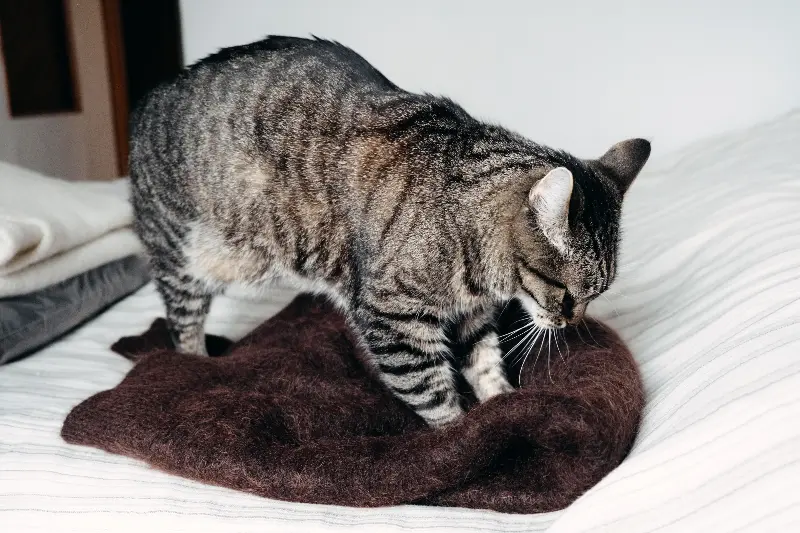
If you’ve ever felt the rhythmic push of paws against your lap, you’ve experienced "making biscuits." This behavior is a powerful throwback to kittenhood. Nursing kittens instinctively knead their mother to stimulate milk flow. When an adult cat does this to a soft blanket or your leg, it signifies:
- Extreme Comfort: It is a sign that the cat feels safe and content in your presence.
- Territory Marking: Cats have scent glands in their paws. By kneading your sofa, they are leaving a chemical signature that says, "This is mine".
3. BUNTING AND FACE RUBBING: AFFECTION OR PROPERTY RIGHTS?
When your cat bumps their head gently against you or rubs their cheeks on your shoes, they are engaging in a behavior called bunting. This is a sophisticated way of communicating safety and ownership.
Cats possess scent glands on their cheeks, forehead, and chin. By rubbing these areas on you, they are depositing pheromones that signal you are a trusted part of their social group. In multi-cat households, this creates a "group scent" that reduces tension. When your cat greets you with a head bunt, it is both a high-level compliment and a formal claim of your friendship.
4. CHATTERING AT BIRDS: THE FRUSTRATED HUNTER
There is nothing quite as peculiar as a cat perched at a window, making a rapid, mechanical clicking sound while staring at a squirrel. This chattering is generally attributed to two main theories:
- Predator Frustration: Because the cat can see the prey but cannot reach it, their excitement and agitation manifest as this unique vocalization.
- The Killing Bite: Some behaviorists believe the jaw movement mimics the specialized "neck bite" cats use in the wild, essentially practicing their technique for a hunt they cannot complete.

5. BRINGING GIFTS: THE ULTIMATE GESTURE OF FAMILY
If your cat leaves a toy (or worse, a mouse) on your pillow, they aren't trying to gross you out. In the feline world, this is a meaningful contribution to the colony.
In nature, mother cats bring back prey to teach their young how to eat and hunt. By presenting you with a "gift," your cat is likely treating you as a member of the family who—in their eyes—is a fairly incompetent hunter in need of a meal. It is a sign of deep social bonding and care.
STRENGTHENING THE CONNECTION
Feline habits may seem mysterious, but they are almost always rooted in ancestral survival strategies. By decoding the zoomies, the chattering, and the "gifts," we get a glimpse into the fascinating psychology of our companions. The next time your cat does something inexplicable, remember: it’s just their way of thriving in your shared home.